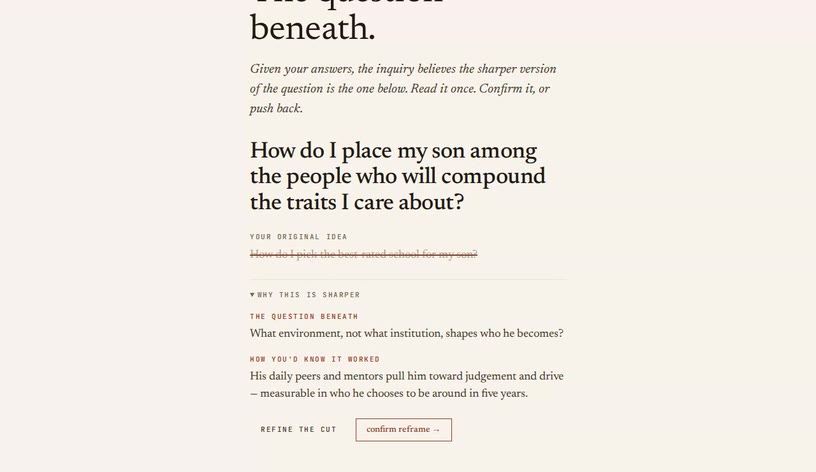
Most ideas fail because they answer the wrong question. We start by deconstructing the thinking — what's actually meant, what's assumed, what sits beneath the version put into words. The aim is to surface the question that’s worth answering.
Then
Defensible answers
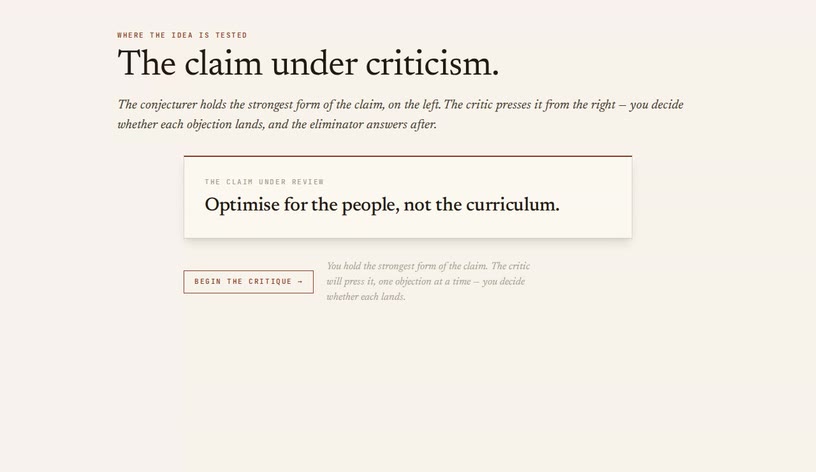
Once the real problem is in view, we work on the most defensible answers — and then test them against the strongest objections we can find. What survives is the most defensible answer reachable today. We provide what didn't survive, so you can see what was tested, and where it gave way.
How it works
1
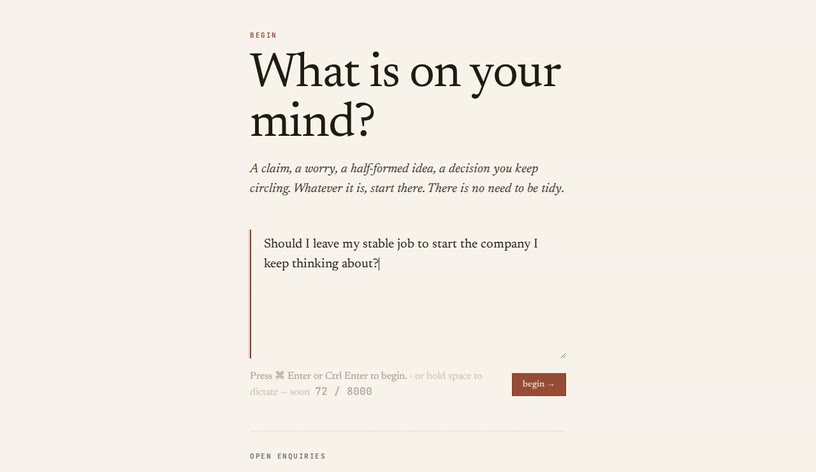
What’s on your mind
Tell us the idea, problem or ask a difficult question
2
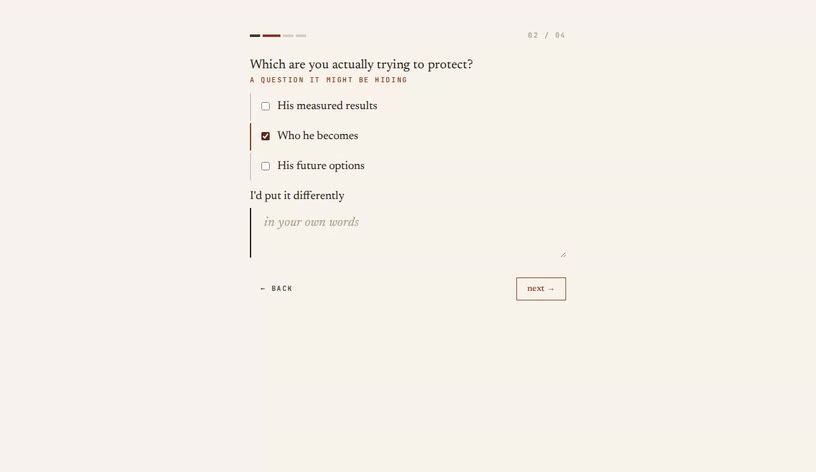
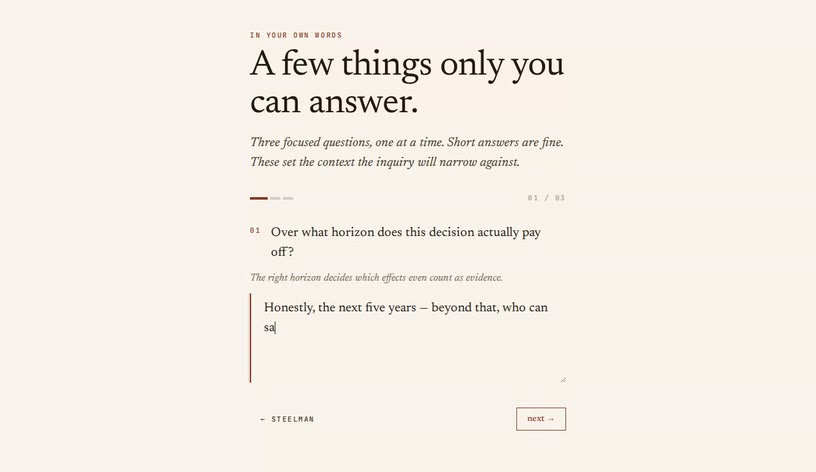
Understanding the problem
We clarify and question, to uncover the deeper problem
3
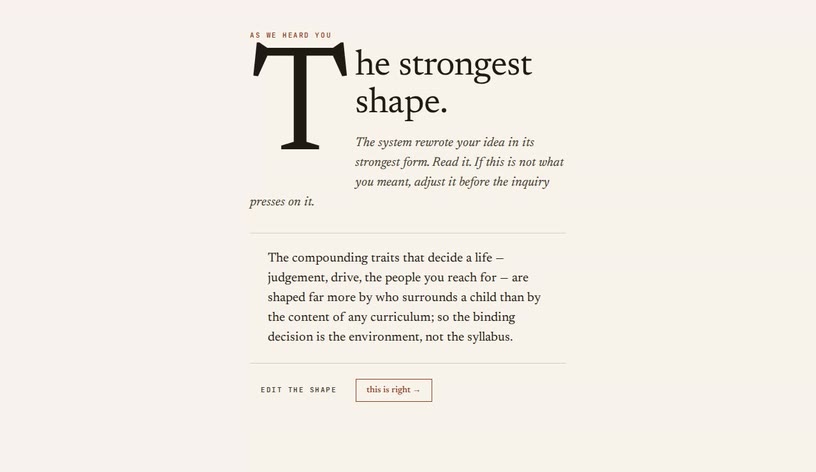
What we heard
Once we understand the problem, we present it in its clearest form
4
Identifying assumptions
We uncover what's assumed, and what could mislead if these assumptions are wrong
5
The problem, formed
We reframe the problem so that candidate solutions can be tested against it
6
Solve, Falsifai and refine
We create grounded solutions which are tested and refined until a defensible path forward emerges
7
The record
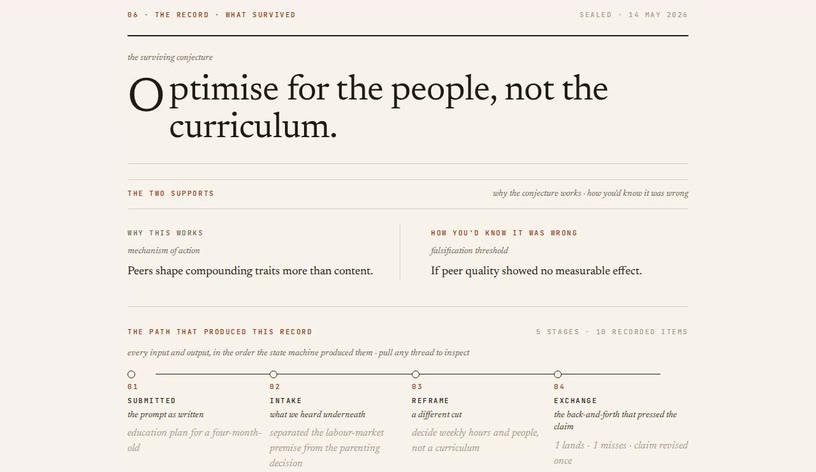
We surface the most defensible path forward, explain why, and call out the unknowns because honest uncertainty is more useful than dishonest certainty
Two disciplines sit beneath everything we do: one for surfacing the right problem to
solve, one for finding and testing the answers. Neither is enough alone. A good answer to
the wrong question is still wrong; an untested answer to the right one is only a guess.
Socrates
Socratic inquiry
Two and a half thousand years ago, Socrates worked out that the best way to think clearly is to be asked the right questions by someone who isn't trying to win. Most AI tools race to answer you; Socrates did the opposite. He slowed down and asked meaningful questions, exposing what everyone else took for granted. We work the same way — patient inquiry, drawing out assumptions, refusing to guess what we don't know, until the real problem beneath your question is in the open.
Karl Popper
Popperian fallibilism
It is easy to find reasons you are right, and sound confident doing so. Karl Popper's discipline runs the other way: no claim can ever be proven true, only failed to be proven false. A thousand confirmations cannot make an idea certain, but a single criticism can prove it false. Criticism, refutation and falsification of ideas is how we truly learn and grow. What survives serious attempts to break it is what you can provisionally trust, knowing it may yet shift when new evidence arrives.
Anyone with something that matters to them and a reason to get it right. Founders making a strategic call, researchers stress-testing a hypothesis, writers shaping an argument, anyone working through a decision they can't easily walk back. The common thread is wanting to be thoughtful and deliberate rather than quick.
How is this different from ChatGPT or other AI tools?
Most AI tools are built to predict an answer to the question you wrote. They answer quickly, confidently, and generally accept the input as you asked it — unstated assumptions and all. Falsifai is built for the life of a decision, focusing on the problem that needs to be solved to give you the answer your question deserves. We slow down, question the framing itself, and look for the best research, best answers, and strongest objections rather than the fastest agreeable reply. You leave with the version of your thinking that survived that scrutiny, and a clear record of 'why'.
If I'm good at prompting, can't I already do this myself?
You can get part of the way — a sharp prompt will get a model to argue back a little. But a single AI model is built, at its core, to be agreeable. Ask it to challenge you and it will perform the motions, then quietly fold the moment you push, because no single model can hold genuine tension against itself for long. That isn't something a better prompt fixes — it's architectural. The discipline that keeps the pressure on your idea instead of relieving it lives in how Falsifai is built and implemented, not in anything you can type. That's the part you can't reproduce from the outside, however good your prompt.
Do I need to know anything about philosophy or fallibilism to use it?
No. You bring something you care about and answer plain questions about it; the method does the rest. You don't need to know the thinking behind it to benefit from it. If you're curious, our philosophy page sets it out — but that's reading for the interested, not a prerequisite.
Is Falsifai just going to tell me I'm wrong?
No — and it isn't really about you being right or wrong at all. Falsifai isn't grading you; it tests whether the idea holds its own weight, on its own merits. Nobody is trying to win — the only aim is the best path forward. Often your thinking holds, now with the reasons made explicit — a clearer understanding, one you can better explain and defend. When something gives way, you're shown exactly where, so you can see it for yourself rather than just be told. And if you want to take a path it didn't recommend — because you believe in it, or because you know something it doesn't — that's yours to take. At least now you know what to watch for. The aim is sharper thinking, not a verdict on you.
What do I walk away with — and can I trust it?
You walk away with the most defensible answer reachable today, the reasoning that got there, and — just as importantly — what didn't survive and what's still uncertain. That last part is the point: Falsifai shows its working, including where it's unsure, because honest uncertainty is more useful than dishonest certainty. We don't ask you to take the answer on faith. You can see what was tested and where it gave way, and decide for yourself. The judgement stays yours; we make sure it's an informed one.
How long does an inquiry take?
Longer than a chat reply, deliberately. Most serious questions take a focused sitting — somewhere between twenty minutes and an hour. You can leave and come back; an inquiry holds its place where you stopped.
Is my thinking private?
Yes. Your inquiries are yours. Nothing you write is published or shared unless you choose to share it, and the only public surface is a record you deliberately publish. Our privacy policy sets out the detail.
Can I use Falsifai at work?
Often, yes — a lot of people reach for Falsifai to support the complex decisions their knowledge work demands. One thing to check first: Falsifai is an AI platform, so before you put anything sensitive or proprietary into it, make sure you're clear on your workplace's own data and privacy policies. Better to know where the lines are than to find out afterward.
How do I get access?
We're admitting in waves — a small first cohort, then wider. Request access with the button on this page and we'll write to you when your wave opens.
We use cookies necessary for the service to function, and — only with your consent — a
first-party analytics cookie to understand usage. No advertising, no third-party trackers,
no sale of data.